Carson’s a statistical anomaly. Ready for some good weirdness?
Carson, WA isn’t even big enough to be a town. No stoplights, one gas station. This “census designated area” is in between three volcanoes, up the road from the Columbia River on the way to the forest, the last stop before you get to some of Washington’s most remote frontier. In a relative sense, little moves in or out.
But there are many unique places in the U.S, right?
Let’s just say Carson’s 2300 people are in a small group of the many thousands of small communities in the U.S. When combined, there’s a statistical anomaly in the age/median income/culture story here.

This puts Carson in a category with a small percentage of communities in the U.S. Crazier still, it’s an “old” community that didn’t get there by way of being a retirement community.
But what’s unusual isn’t just the number…it’s also the trajectory. A few decades ago Carson looked like the U.S. and PNW. But it has aged FIVE times faster since. This is highly unusual, statistically speaking.
A pastoral challenge? Internally, we risk having expectations that a new pastor will return CBC to its “heyday” when they had to have two services, kids were everywhere, and money was flowing.
But now we know statistically something everyone here knows experientially… 25 years later they’ve closed the local middle school. The valley has aged unusually relative to everywhere else.
The bottom line
In sum, this isn't just an older town…it’s becoming one of the oldest ordinary communities in America (that is not intentionally a retirement community). Not because thousands of retirees moved here, but because young people left, fewer young families arrived, and those who stayed faithfully built this community together. It’s not a criticism…it’s simply today’s inherited reality.
And it’s a clue about where ministry needs are greatest. This especially includes youth precisely because of the predominance of older generations. It’s a real opportunity for CBC to be regionally influential because people in the Gorge drive for what they need, and CBC’s got thriving TrailLife and children’s ministries.
Wait! There’s more.
Everyone knows that affordability’s an issue everywhere, and here in the Columbia Gorge we’re right on the border between C- (Washington) and D- (Oregon) for housing affordability. But Carson gets even weirder than that, unlike other Gorge towns just a few miles away.
If age in Carson makes it look like it got stuck in time, the economics affirm the story.
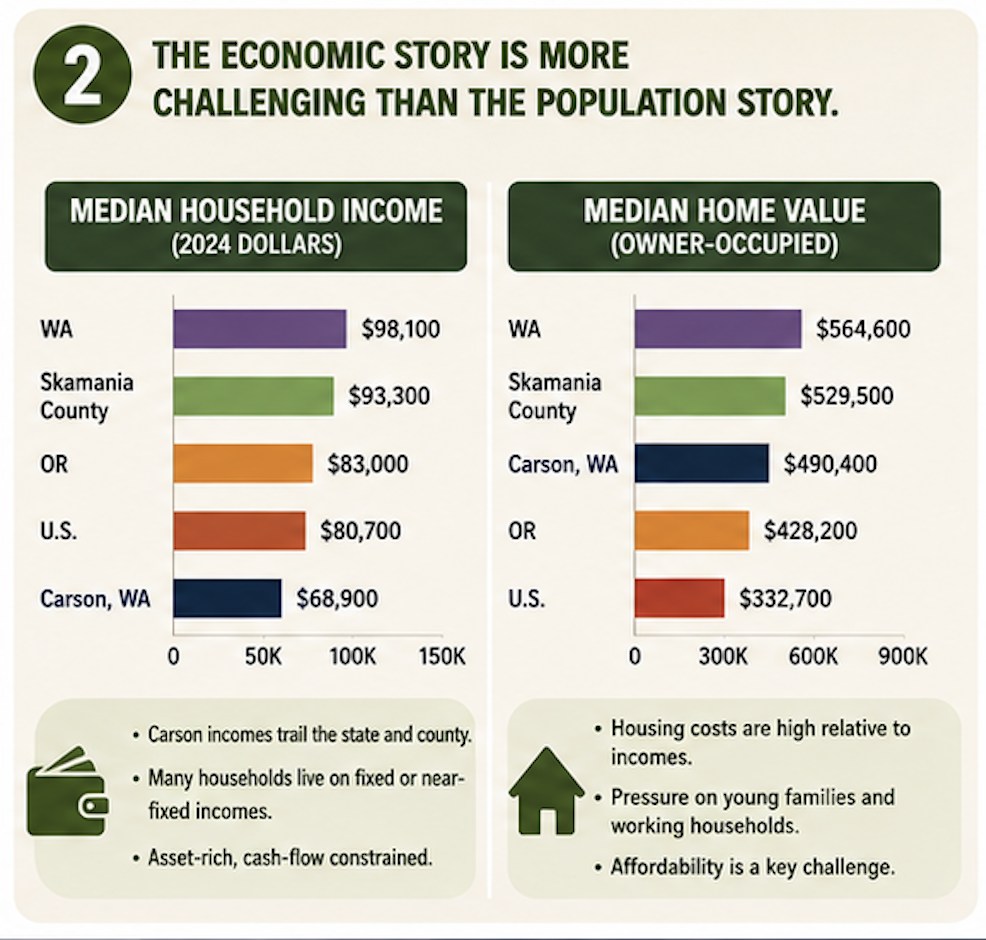
Housing prices in Carson are comparable to Portland (one hour away), but median income in Carson has risen less than $6000 since 1990 and is now ~30% lower than the state average.
Functionally, Carson stopped growing. The whole valley — and CBC also — began existing like fixed-income retirees. Let me explain.
Here’s the rub
What happens when someone retires on a fixed income? Over time — especially if it’s a long retirement — the world starts closing in. Rising cost of living means decreasing discretionary income. Further, decreasing physical capacity means projects that may have once been DIY (e.g., repairing a roof, painting some walls, keeping up the yard, replacing the carpet that was new in 1993…) go untouched.
And that’s Carson Bible Church. It’s historic, it’s known for faithful and hardworking pastors and elders, and it’s a place everyone within driving distance knows about. A few decades ago it looked like the rest of the PNW… they built a bigger sanctuary, hosted multiple services, and no doubt had an sense of community that happens when things are moving and shaking.
Three decades later? It’s a bit like having that hard conversation with your parents when a) their fixed income doesn’t go as far as it used to b) they just can’t take care of the house and ranch the way they once did.
It’s not failure, it’s just time. It’s a trend that isn’t a mystery about where it goes.
The bottom line, for real this time
Gorge-ites live here on purpose, and this is doubly true for Carson (which is smack in the middle). It’s not Portland or Seattle. All that’s good.
But the good-weirdest part of the story isn’t aging valleys and churches. And it’s not, per se, people living at the end of the grid or even a sparsely-populated county being disrupted by encroaching change.
It’s how God clearly keeps showing up. …showing up in the faithful people who keep showing up. It’s weird good. (Stay tuned for the many stories of how even in our short time here)
Like a zillion other community churches, they just can’t afford a full time pastor. And while the whole region they’ve long touched still knows CBC, they don’t have the people-energy they once did. Naturally, their world has shrunk in a natural and naturally cyclical sort of way.
That’s the opportunity before us…a faithful history and legacy in a natural season. And one that also happens to be smack in the middle of a totally anomalous populace — a world with deep spiritual needs due to aging, poverty, and utter economic stagnation.
Or as I think of it, good weird.
***
Hey, Lord of the Harvest, we kinda need some help over here. Help us be faithful stewards as we trust You to protect and provide for Your flock. Amen.